Understanding Psychooncology and Counseling Support for Mental Health

Cancer affects far more than the body. A diagnosis can change how a person sleeps, thinks, relates to others, makes plans, and understands the future. For many people, the emotional weight of cancer begins before treatment and continues long after medical care ends.
Psychooncology is the field that focuses on this connection between cancer and mental health. It looks at the emotional, social, behavioral, spiritual, and practical challenges that can come with cancer for patients, survivors, caregivers, and families.
This post is for informational purposes only and does not replace medical care, mental health treatment, or crisis support. Anyone facing thoughts of self-harm, suicide, or immediate danger should call 988 in the United States or go to the nearest emergency room.

What psychooncology means
Psychooncology, also written as psycho-oncology, is a specialty area within cancer care and mental health. It brings together psychology, psychiatry, social work, counseling, oncology, nursing, palliative care, and spiritual care. The goal is to understand and treat the emotional and psychological concerns that can arise across the cancer experience.
The field became more visible as cancer care improved and more people lived longer after diagnosis. As survival increased, clinicians and researchers paid closer attention to quality of life, emotional distress, family stress, body image, fear of recurrence, and adjustment after treatment (Holland et al., 2015).
Psychooncology does not assume that every person with cancer will develop a mental health disorder. Many people cope with cancer using their existing supports, beliefs, routines, and strengths. At the same time, cancer can create intense stress that deserves serious attention.
Common psychooncology concerns include:
Fear and uncertainty after diagnosis
Anxiety before scans, surgery, chemotherapy, radiation, or immunotherapy
Depression, grief, or loss of motivation
Sleep problems and fatigue
Changes in body image, sexuality, or identity
Strain in relationships and caregiving roles
Financial stress and work disruption
Spiritual distress or questions about meaning
Fear of recurrence after treatment ends
Adjustment to advanced cancer or palliative care
The National Comprehensive Cancer Network has described distress as a common experience in cancer care that can range from normal worry to disabling emotional suffering (National Comprehensive Cancer Network, 2024). This broad view matters because people do not need to be in crisis before support is appropriate.
How cancer can affect mental health
Cancer can affect mental health in several overlapping ways. The diagnosis itself may feel shocking. Treatment can be physically demanding. Side effects can change daily routines. Medical uncertainty can make it hard to plan. Even after treatment ends, some people feel emotionally unsettled because the structure of active care is gone.
Research has consistently shown that depression, anxiety, and adjustment difficulties are more common among people with cancer than in the general population, though rates vary by cancer type, stage, treatment status, and personal history (Mehnert et al., 2014; Mitchell et al., 2011).
That does not mean cancer “causes” one predictable emotional response. People respond in many ways. Some feel numb. Some feel angry. Some focus on practical tasks. Some move between hope and fear in the same hour.

Anxiety and fear of the unknown
Anxiety often grows around uncertainty. A person may worry about test results, whether treatment will work, side effects, pain, finances, or how loved ones are coping. Many people describe “scanxiety,” a sharp rise in worry before imaging or lab results.
Anxiety can show up as:
Racing thoughts
Muscle tension
Shortness of breath
Restlessness
Trouble sleeping
Irritability
Avoiding appointments or conversations
Some anxiety is understandable during cancer care. It becomes more concerning when it interferes with eating, sleeping, decision-making, treatment attendance, or daily life.
Depression, grief, and loss
Cancer can bring real losses. A person may lose energy, privacy, independence, fertility, hair, physical comfort, income, or a sense of safety in the body. Depression may develop when sadness becomes persistent and is joined by hopelessness, loss of interest, isolation, guilt, or thoughts of death.
Depression in cancer care can be hard to identify because some symptoms overlap with treatment side effects. Fatigue, appetite changes, and sleep disruption may come from chemotherapy, pain, medications, or depression. This is one reason careful assessment matters.
Clinicians often look at emotional, cognitive, and behavioral signs along with physical symptoms. Feelings of worthlessness, ongoing hopelessness, withdrawal, or thoughts of self-harm call for prompt support.
Body image, identity, and relationships
Cancer treatment can change how a person looks and feels in the body. Surgery, scars, ostomies, weight changes, hair loss, swelling, sexual changes, and fatigue can affect self-confidence and intimacy.
Relationships may also shift. A partner may become a caregiver. Children may need reassurance. Friends may not know what to say. Some people feel supported, while others feel lonely even when surrounded by help.
These changes can affect identity. A person may wonder, “Am I still myself?” or “Will life ever feel normal again?” Psychooncology gives space for these questions without treating them as weakness.
Why distress screening matters
Cancer programs increasingly recognize emotional distress as part of whole-person care. Bultz and Carlson (2005) famously described distress as the “sixth vital sign” in cancer care, meaning it should be noticed alongside physical signs such as pain, temperature, heart rate, breathing, and blood pressure.
Screening does not label someone as unable to cope. It helps identify who may need more support.
A care team may ask questions about:
Mood and anxiety
Sleep
Pain and fatigue
Practical needs
Family concerns
Spiritual concerns
Safety
Substance use
Coping and support systems
Some settings use brief tools, such as distress rating scales, to start the conversation. These tools are not the same as a full mental health evaluation, but they can help clinicians decide whether someone may benefit from counseling, psychiatry, social work, support groups, or palliative care (Andersen et al., 2014).

How counseling may help during cancer care
Counseling can help people face cancer with more support, clarity, and coping skills. It does not remove the medical reality of cancer, and it does not require forced positivity. Good counseling makes room for fear, grief, anger, hope, and practical problem-solving.
Research suggests that psycho-oncologic interventions can reduce emotional distress and improve quality of life for many people with cancer, especially when support is matched to the person’s needs (Faller et al., 2013).
Counseling can help people name what is happening
Many people try to stay strong by pushing feelings away. That may work for a short time, especially during the rush of appointments and decisions. Over time, untreated distress can build.
A counselor can help a person slow down and name the experience:
“I feel terrified before every scan.”
“I am angry that my body has changed.”
“I do not want to burden my family.”
“I feel guilty that I survived.”
“I do not know how to live with uncertainty.”
Naming feelings can reduce shame. It can also help the care team understand what kind of support is needed.
Counseling teaches skills for anxiety and stress
Counseling often includes practical tools that can be used during treatment, recovery, or survivorship. These may include breathing exercises, grounding skills, sleep routines, thought tracking, relaxation training, and communication planning.
Cognitive behavioral therapy can help people notice patterns between thoughts, feelings, and behaviors. For example, a thought such as “Every pain means the cancer is back” may increase panic and lead to repeated checking. Counseling can help test that thought, plan when to contact the medical team, and reduce the cycle of fear.
Acceptance and commitment therapy can help people live according to personal values while making space for fear and uncertainty. Meaning-centered approaches can support people who are asking deeper questions about purpose, legacy, faith, family, or what matters most.
Counseling supports communication and decision-making
Cancer care often requires difficult conversations. A person may need to talk with an oncologist about treatment options, tell children about a diagnosis, ask for help at home, discuss intimacy with a partner, or make decisions about advanced care.
Counseling can help prepare for these conversations. It can also help people identify their values so medical decisions feel less overwhelming.
For example, one person may value more aggressive treatment if it offers more time. Another may prioritize comfort, independence, or fewer hospital visits. Counseling does not tell people what to choose. It helps them understand what matters and communicate it clearly.
Counseling helps caregivers and families too
Caregivers often carry fear, exhaustion, and responsibility while trying to stay calm for the person with cancer. They may manage appointments, medications, insurance calls, household tasks, and emotional support.
Family or couples counseling can help reduce conflict, clarify roles, and make room for honest feelings. It can also help families talk about children, boundaries, caregiving fatigue, and changing intimacy.
Caregivers may benefit from individual counseling as well. Their distress matters, even when they are not the patient.
What good psychooncology support looks like
Effective support is compassionate, practical, and connected to the medical reality of cancer. A counselor working in this area should understand that cancer care can include medical trauma, uncertainty, physical symptoms, cultural beliefs, family dynamics, and end-of-life concerns.
A person may receive support from a:
Licensed professional counselor
Clinical social worker
Psychologist
Psychiatrist
Oncology social worker
Chaplain or spiritual care provider
Palliative care clinician
Support group facilitator
Psychiatrists and some medical clinicians can also evaluate whether medication may help with depression, anxiety, panic, sleep, or other concerns. Medication is not the right choice for everyone, but it can be helpful when symptoms are severe, persistent, or interfering with care.
The best support often involves coordination. For example, a counselor may help with anxiety while an oncology social worker assists with transportation or financial stress. A palliative care team may help with pain and quality of life, while a psychiatrist helps manage panic or depression.
When to seek counseling support
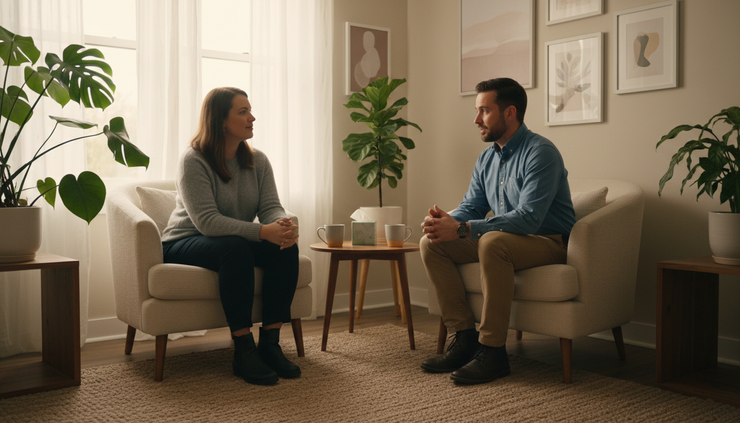
Counseling can help at any point in the cancer experience. A person does not need to wait until distress feels unbearable.
Support may be especially helpful when someone experiences:
Persistent sadness, fear, anger, or numbness
Panic attacks or severe anxiety before appointments
Trouble sleeping most nights
Loss of interest in usual activities
Withdrawal from loved ones
Difficulty making treatment decisions
Conflict with family or caregivers
Heavy guilt or shame
Fear of recurrence that disrupts daily life
Thoughts of self-harm or not wanting to live
Immediate help is needed if someone may harm themselves or cannot stay safe. In the United States, calling or texting 988 connects people with the Suicide and Crisis Lifeline.
For non-emergency support, a good first step is to ask the oncology team for a referral. Many cancer centers have social workers, psychologists, psychiatrists, or counselors familiar with cancer-related distress. Community therapists can also help, especially if they have experience with health psychology, grief, trauma, chronic illness, or caregiver stress.
The main takeaway
Psychooncology recognizes a simple truth: cancer care is not only physical care. Mental health, relationships, identity, grief, fear, and meaning all matter.
Counseling can help people and families cope with uncertainty, reduce distress, improve communication, and find steadier ground during a deeply stressful time. Reaching for support is not a sign of weakness. It is part of caring for the whole person.
References
Andersen, B. L., DeRubeis, R. J., Berman, B. S., Gruman, J., Champion, V. L., Massie, M. J., Holland, J. C., Partridge, A. H., Bak, K., Somerfield, M. R., & Rowland, J. H. (2014). Screening, assessment, and care of anxiety and depressive symptoms in adults with cancer: An American Society of Clinical Oncology guideline adaptation. Journal of Clinical Oncology, 32(15), 1605-1619. https://doi.org/10.1200/JCO.2013.52.4611
Bultz, B. D., & Carlson, L. E. (2005). Emotional distress: The sixth vital sign in cancer care. Journal of Clinical Oncology, 23(26), 6440-6441. https://doi.org/10.1200/JCO.2005.02.3259
Faller, H., Schuler, M., Richard, M., Heckl, U., Weis, J., & Küffner, R. (2013). Effects of psycho-oncologic interventions on emotional distress and quality of life in adult patients with cancer: Systematic review and meta-analysis. Journal of Clinical Oncology, 31(6), 782-793. https://doi.org/10.1200/JCO.2011.40.8922
Holland, J. C., Breitbart, W. S., Jacobsen, P. B., Lederberg, M. S., Loscalzo, M. J., & McCorkle, R. (Eds.). (2015). Psycho-oncology (3rd ed.). Oxford University Press.
Mehnert, A., Brähler, E., Faller, H., Härter, M., Keller, M., Schulz, H., Wegscheider, K., Weis, J., Boehncke, A., Hund, B., Reuter, K., Richard, M., Sehner, S., Sommerfeldt, S., Szalai, C., Wittchen, H. U., & Koch, U. (2014). Four-week prevalence of mental disorders in patients with cancer across major tumor entities. Journal of Clinical Oncology, 32(31), 3540-3546. https://doi.org/10.1200/JCO.2014.56.0086
Mitchell, A. J., Chan, M., Bhatti, H., Halton, M., Grassi, L., Johansen, C., & Meader, N. (2011). Prevalence of depression, anxiety, and adjustment disorder in oncological, haematological, and palliative-care settings: A meta-analysis of 94 interview-based studies. The Lancet Oncology, 12(2), 160-174. https://doi.org/10.1016/S1470-2045(11)70002-X
National Comprehensive Cancer Network. (2024). NCCN guidelines for patients: Distress during cancer care. NCCN Foundation.


Comments